
If you’ve ever wondered why cigarettes are so expensive, the short answer is tax – and Canada piles on more of it than almost anywhere else in the world. A single pack that cost $5 in the 1990s now runs $15 to $25 at a gas station, depending on the province. Most of that price increase isn’t tobacco, manufacturing, or even corporate profit. It’s layers of government levies stacked on top of each other, with a retail markup added at the end. This article breaks down exactly where your money goes, why prices keep rising, how they differ across provinces, and what your options look like if you’re tired of paying full freight.
Quick answer: what makes Canadian cigarettes so expensive?
- Federal excise duty is the largest single cost driver – a per-cigarette tax applied nationally before a pack reaches any store shelf.
- Provincial tobacco tax adds another substantial layer, and it varies significantly by province.
- GST/HST is applied to the full price after all other taxes are already baked in, so you pay tax on top of tax.
- Retail markup from the distributor, wholesaler, and store is added last, after all the above.
- Annual indexing means federal excise rates increase automatically with inflation, so prices climb without Parliament needing to vote on it each year.
- Native cigarettes bought factory-direct carry a different tax treatment and no retail markup, which is why the price gap is so large.
What is actually in the price of a cigarette pack?
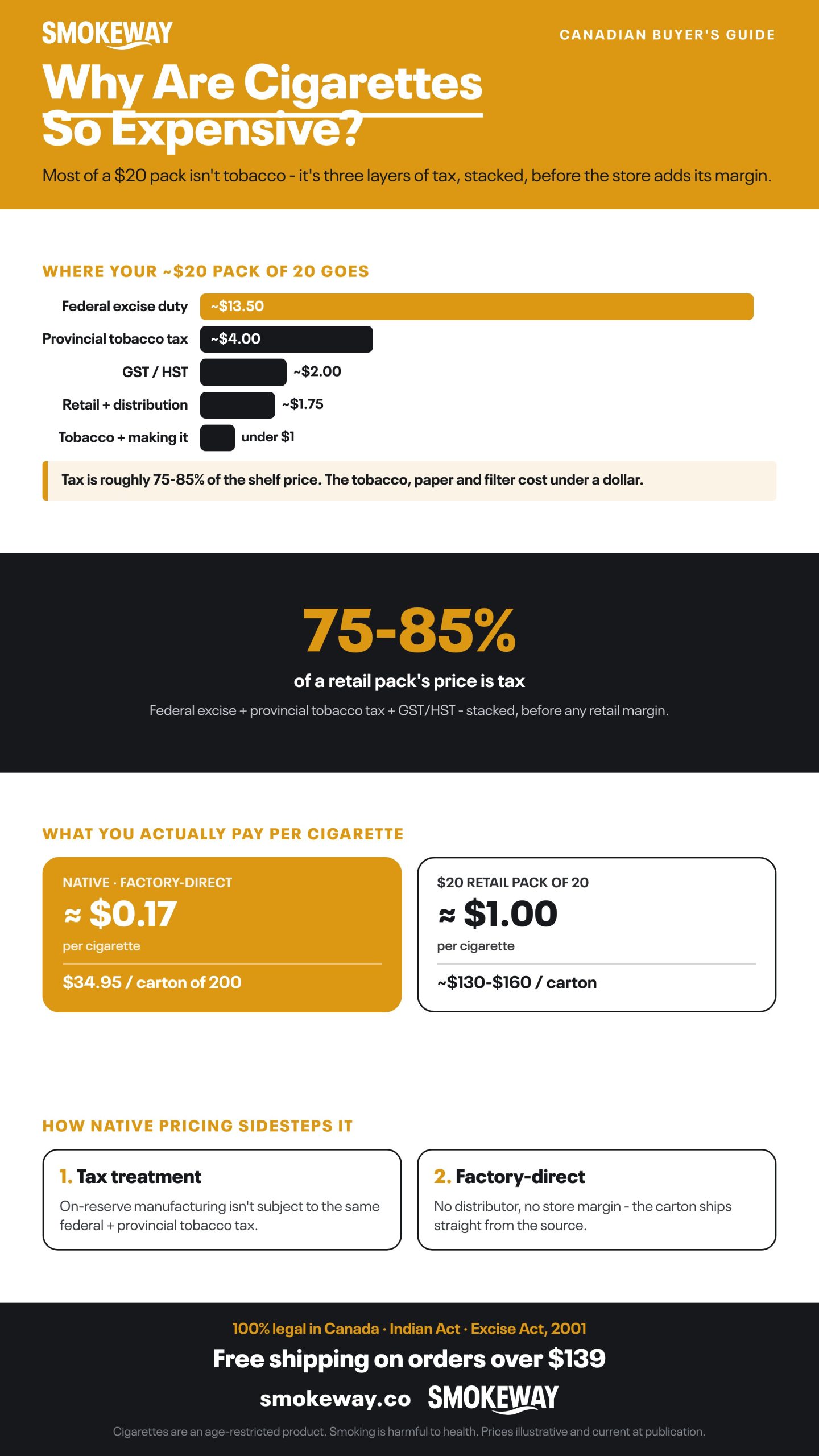
Break a $20 pack down and most of what you’re paying isn’t the cigarette itself. The tobacco, paper, filter, and packaging cost far less than a dollar per pack to produce. The rest is a series of government levies and margin layers applied one after another.
Federal excise duty is set by the Government of Canada under the Excise Act, 2001. As of early 2026, the rate is approximately $0.68 per cigarette (based on published CRA excise duty schedules – see References). On a pack of 20 that’s roughly $13.60 in federal tax alone, before the province touches it.
Provincial tobacco tax is added on top. Every province has its own rate, ranging from around $0.15 per cigarette in some provinces to over $0.40 in others. A pack of 20 can carry an additional $3 to $8 in provincial levy, depending on where you live.
GST and HST apply to the full retail value, including the excise duty and provincial tax already embedded in the price. In a province with 13% HST, you’re paying HST on a price that already includes $15+ in tax. That’s tax compounding on tax.
Retail margin is the final layer. Convenience stores and gas stations don’t sell cigarettes at cost. Distributor, wholesaler, and retailer margins together typically add $1 to $3 per pack.
The table below shows a rough illustrative breakdown for a $20 pack of 20 cigarettes in a province with HST. These are estimates intended to show proportions, not precise regulatory figures.
| Cost component | Estimated amount (pack of 20) | Notes |
|---|---|---|
| Tobacco + manufacturing | ~$0.50 – $1.00 | Leaf, paper, filter, packaging |
| Federal excise duty | ~$13.00 – $14.00 | Per-cigarette rate, CRA Excise Act 2001 |
| Provincial tobacco tax | ~$2.50 – $6.00 | Varies widely by province (see table below) |
| GST / HST | ~$1.50 – $2.50 | Applied to full retail price including taxes |
| Distribution and retail markup | ~$1.00 – $2.50 | Wholesaler + store margin |
| Total (estimate) | ~$18.00 – $26.00 | Range reflects provincial variation |
The take-home point: the cigarette itself is a small fraction of what you pay. Tax accounts for 75% to 85% of the shelf price by most estimates. Retail is the rest.
Federal excise duty: the biggest single piece
The federal excise duty on cigarettes is levied under the Excise Act, 2001 and administered by the Canada Revenue Agency. It applies at a flat per-cigarette rate, set in dollars, not as a percentage of price. That matters because it hits a cheap pack and an expensive pack equally – there’s no sliding scale.
The rate has been raised numerous times since 2001, and since 2014 it has been indexed to the Consumer Price Index. That indexing is the key mechanism behind automatic annual price increases. Parliament doesn’t vote on it. The rate adjusts upward with inflation each year on April 1, quietly and automatically. Even if you don’t feel inflation in your grocery bill, you feel it at the tobacco counter.
Why prices keep climbing every year
CPI indexing is one part of the picture. Governments have also made deliberate one-off excise increases beyond the annual inflation adjustment – most recently in the 2023 federal budget, which added an additional 2% on top of the regular CPI increase (StatCan data, see References). Some provinces have also raised their own tobacco tax rates independently.
The cumulative effect is compounding. Each increase raises the base on which the next year’s indexing applies. The higher the price goes, the more absolute dollars the next percentage increase generates. A pack that cost $8 in 2005 and now costs $20+ didn’t get there by accident – it got there through roughly two decades of stacked increases, each building on the last.
There is also no sign the trend will reverse. Federal and provincial governments have both stated long-term tobacco reduction targets, and excise duty is their primary lever to discourage smoking. For people who continue to smoke regardless, the policy just means paying more every year for the same product.
How tobacco tax varies by province
Provincial tobacco tax is where you see the biggest differences in what Canadians actually pay at the counter. Every province sets its own rate. The table below shows estimated provincial tobacco tax per cigarette and the rough implied tax on a pack of 20, based on publicly available provincial tax schedules as of early 2026. These are estimates – verify current rates with your provincial government (see References).
| Province / Territory | Est. prov. tax per cigarette | Est. prov. tax per pack of 20 | Typical retail pack price (est.) |
|---|---|---|---|
| British Columbia | ~$0.295 | ~$5.90 | $18 – $23 |
| Alberta | ~$0.27 | ~$5.40 | $17 – $22 |
| Saskatchewan | ~$0.27 | ~$5.40 | $17 – $22 |
| Manitoba | ~$0.31 | ~$6.20 | $18 – $23 |
| Ontario | ~$0.184 | ~$3.68 | $16 – $21 |
| Quebec | ~$0.299 | ~$5.98 | $18 – $24 |
| New Brunswick | ~$0.275 | ~$5.50 | $18 – $23 |
| Nova Scotia | ~$0.30 | ~$6.00 | $19 – $24 |
| PEI | ~$0.35 | ~$7.00 | $20 – $25 |
| Newfoundland and Labrador | ~$0.42 | ~$8.40 | $21 – $26 |
| Yukon | ~$0.30 | ~$6.00 | $19 – $24 |
| Northwest Territories | ~$0.43 | ~$8.60 | $21 – $26 |
| Nunavut | ~$0.415 | ~$8.30 | $21 – $27 |
Note: all figures are estimates based on published provincial tax schedules. Retail prices vary between stores and change with each federal and provincial budget cycle. Check your provincial revenue or finance ministry website for current rates.
Newfoundland, Nunavut, and the Northwest Territories consistently rank among the most expensive jurisdictions. Ontario sits lower than many provinces on the provincial rate, but federal duty applies everywhere, so the gap between cheapest and most expensive is smaller than people expect.
How native cigarettes sidestep a chunk of the cost
The large price gap between native cigarettes and commercial retail comes down to two things: a different tax treatment and no retail markup.
Tax treatment: Native cigarettes manufactured on First Nations land and sold within a First Nations context operate under a different regulatory structure. The full federal excise duty that applies to commercial cigarettes at the tobacco manufacturer level does not apply in the same way to product manufactured and sold within these channels. Provincial tobacco tax arrangements vary by province and by specific First Nations agreements. The result is a substantially lower tax burden compared to a commercial cigarette that goes through a national manufacturer, a provincial distributor, and a retail chain.
No retail markup: When you buy factory-direct from us, there’s no gas station margin, no regional distributor cut, no wholesaler taking a slice. The product goes from the manufacturing floor to a carton, and from that carton to your door. The markup layers that account for $1 to $3 per retail pack don’t exist.
Put those two together and the numbers are stark. A native carton of 200 cigarettes (8 packs of 25) from Smokeway costs $34.95 to $36.95 – roughly $0.17 per cigarette. At a gas station, a pack of 20 commercial cigarettes for $20 works out to $1.00 per cigarette. Same basic product – tobacco, paper, filter. A price gap driven almost entirely by the tax and distribution structure, not by quality.
How to pay less without quitting
If the cost of smoking is the issue but you’re not interested in stopping, there are straightforward ways to reduce what you spend without doing anything unusual.
Switch to native cigarettes. This is the biggest single lever. The price per cigarette at native factory-direct pricing is a fraction of the retail rate. Even if you smoke the same amount, your monthly spend drops sharply.
Buy by the carton, not by the pack. Buying individual packs is the most expensive format regardless of where you buy them. A native carton at $34.95 covers 200 cigarettes. The equivalent at retail could run $130 to $160 for the same count.
Order enough to hit free shipping. Our free shipping threshold is $139, which works out to roughly four cartons. Splitting a combined order with someone in your household is a simple way to clear the line without overstocking. We ship across Canada – every province and territory.
Stock up before budget season. Federal excise duty increases take effect April 1 each year. Provincial budgets drop at different points through the year. Buying ahead of a known increase locks in the current price.
Our value brand lineup
If you’re switching from retail and want to start at the lowest possible cost per cigarette, these are the brands to look at. Every one comes in a 25-cigarette pack – eight packs per carton, 200 cigarettes total.
- Putter’s – Light and Full Flavour. Straightforward, no-fuss smoke at $34.95 a carton. One of the most consistent value picks in the range.
- BB – Full and Lights. Clean, approachable profile. $34.95 a carton.
- Nexus – Full and Lights. Good for smokers who want a familiar, balanced draw without paying premium brand prices. $34.95 a carton.
- Canadian – Full, Lights, and Menthol. The flagship line. $34.95 a carton and a solid all-round choice if you want a full-bodied smoke.
All four are manufactured factory-direct, shipped sealed, and arrive in the same 25-cigarette packs that are standard across our full cigarette range.
The cigarette price increase timeline: a brief history
Understanding why prices are where they are now means knowing where they came from. Canada’s tobacco tax story is one of deliberate, sustained escalation over several decades.
In the early 1990s, federal and provincial governments raised tobacco taxes sharply. By 1994, prices had risen enough that cross-border smuggling had become widespread. The government responded by temporarily rolling back federal and some provincial tobacco taxes to undercut the smuggling market.
From the late 1990s onward, taxes climbed steadily again. The 2001 Excise Act modernised the federal duty structure. Through the 2000s and 2010s, rates were raised multiple times by both federal and provincial governments under the banner of tobacco reduction policy.
The indexing mechanism, introduced federally in 2014, changed the dynamic permanently. Once indexing was in place, prices stopped requiring active political decisions to rise – they rise automatically. Add in the extra above-inflation increases in budget years, and you have a structural guarantee that cigarette prices will continue to go up faster than most other household goods.
Is the government price strategy working?
Smoking rates in Canada have fallen significantly over the past 30 years. Statistics Canada data shows adult daily smoking rates dropping from around 25% in the early 1990s to below 12% by the early 2020s. Researchers and public health advocates credit tax increases as a meaningful contributor to that decline, alongside smoke-free legislation and public awareness.
For the roughly 12% of adult Canadians who still smoke, however, the policy hasn’t produced cessation – it’s produced a higher monthly bill. Whether that’s an acceptable trade-off from a policy perspective is a separate debate. From a personal finance perspective, the math is simple: if you’re going to smoke, you need to manage what you pay for it.
Key takeaways
- Federal excise duty is the single largest component of a cigarette pack’s price – approximately $13 to $14 per pack of 20 in 2026.
- Provincial tobacco tax adds another $3 to $8+ depending on where you live, with Newfoundland, Nunavut, and NWT at the top of the range.
- GST/HST is applied after all other taxes, meaning you pay sales tax on a price already heavily taxed.
- Annual CPI indexing has built automatic price increases into the system since 2014, without requiring any vote.
- Native cigarettes bought factory-direct carry a different tax treatment and no retail markup – the cost difference is structural, not a gimmick.
- A native carton of 200 cigarettes costs $34.95 to $36.95 from Smokeway – roughly $0.17 per cigarette versus $1.00 or more at retail.
- Free shipping on orders over $139 makes bulk ordering the most cost-effective way to buy.
Conclusion
Cigarettes in Canada are expensive because three different levels of government each take a cut, and they take it before retail margin is even added. Federal excise duty, provincial tobacco tax, and GST/HST together account for the vast majority of what you pay at the counter. Annual indexing means the price increases without anyone having to make a decision about it. That’s not going to change.
What can change is how you buy. If you’re paying full retail prices and you haven’t looked at what native cigarettes factory-direct cost, the comparison is worth doing once. A carton of 200 for under $37, delivered across Canada, against $130+ for the same count at a gas station – the difference is the tax and markup structure, not the tobacco. When you’re ready to stock up, browse the full range and we’ll get it to your door.
Why Are Cigarettes So Expensive in Canada? FAQ
Why are cigarettes so expensive in Canada compared to other countries?
Canada applies both a federal excise duty and provincial tobacco tax simultaneously, stacked on top of each other, with GST/HST on the combined amount. Many other countries apply only one national tobacco tax. The combined Canadian rate is among the highest in the world, which is why a pack that might cost the equivalent of $5 to $8 USD in parts of the US or Europe can run $20+ in Canada.
What is the cigarette tax in Canada?
There are two main taxes. The federal excise duty is applied per cigarette under the Excise Act, 2001 – approximately $0.68 per cigarette as of early 2026, which works out to roughly $13.60 per pack of 20. Provincial tobacco tax is additional, ranging from around $0.15 to over $0.42 per cigarette depending on the province. GST or HST is then applied to the full retail price. All figures are estimates – check the CRA and your provincial finance ministry for current rates.
Why do cigarette prices increase every year?
Since 2014, federal excise duty on cigarettes has been indexed to the Consumer Price Index. This means the rate adjusts automatically upward on April 1 each year with inflation, without requiring a vote. Federal budgets have also added above-inflation increases in some years, such as the additional 2% increase in 2023. Provincial rates also change independently through provincial budget cycles.
Which province has the highest cigarette tax in Canada?
Newfoundland and Labrador, Nunavut, and the Northwest Territories consistently have the highest provincial tobacco tax rates, with some of the highest total retail prices as a result. PEI also sits near the top of provincial rates. Ontario tends to have a lower provincial rate than most, though the federal duty applies uniformly across the country.
How much of a cigarette pack’s price is tax?
Estimates suggest that tax makes up roughly 75% to 85% of the total retail price of a commercial cigarette pack in Canada, with manufacturing, distribution, and retail margin making up the remainder. The tobacco, paper, and filter cost a fraction of what you pay at the counter. Most of your money goes directly to federal and provincial governments.
Are native cigarettes legal in Canada?
Yes. Native cigarettes manufactured on First Nations land and sold through appropriate channels are legal. They operate under a different regulatory and tax framework than commercial cigarettes sold through national manufacturer and distributor channels. Smokeway manufactures and sells factory-direct within this framework. For a fuller explanation, see our native cigarette brands overview.
Why are native cigarettes so much cheaper than retail?
Two reasons. First, the tax treatment for cigarettes manufactured on First Nations land and sold within that context is different from the full commercial excise duty structure. Second, buying factory-direct eliminates the distributor, wholesaler, and retail store markups that each take a cut of the retail price. Together these two factors account for most of the price gap.
How much does a carton of native cigarettes cost?
Our native cartons run $34.95 to $36.95 for 200 cigarettes (8 packs of 25). That works out to roughly $0.17 per cigarette. The equivalent count at a gas station – 200 commercial cigarettes – could easily cost $130 to $160 depending on the province. Orders over $139 ship free anywhere in Canada.
Will cigarette prices in Canada keep going up?
Based on current policy, yes. Federal excise duty increases automatically with CPI each April 1, so unless the indexing mechanism is removed by Parliament, prices will rise every year. Federal budgets have also added extra above-inflation increases in recent years. No federal or provincial government has signalled an intention to reduce tobacco taxes.
What’s the cheapest legal way to buy cigarettes in Canada?
Buying native cigarettes factory-direct by the carton is the most cost-effective legal option. Value brands like Putter’s, BB, and Nexus at $34.95 per carton, ordered in enough volume to clear the $139 free-shipping threshold, gives you the lowest possible cost per cigarette. We deliver across Canada, so you don’t need to be near a reserve or a specific retailer to access native pricing.
References
- Canada Revenue Agency, Excise Duty Rates (tobacco products): https://www.canada.ca/en/revenue-agency/services/forms-publications/publications/edrates/excise-duty-rates.html
- Government of Canada, Excise Act, 2001 (S.C. 2002, c. 22): https://laws-lois.justice.gc.ca/eng/acts/E-14.1/
- Statistics Canada, Canadian Tobacco and Nicotine Survey: https://www150.statcan.gc.ca/n1/pub/82-003-x/2023010/article/00001-eng.htm
- Government of Canada, Federal Budget 2023 – Tobacco Measures: https://www.canada.ca/en/department-finance/news/2023/03/budget-2023.html
- Government of Canada, Tobacco Control Programme overview: https://www.canada.ca/en/health-canada/services/health-concerns/tobacco.html

Sandy tracks cigarette pricing, federal and provincial tobacco tax, and the native tobacco trade across all ten provinces, turning the numbers into plain-English buying advice. BCom (Economics), University of Guelph. Last reviewed May 2026.